
What Actually Happens When You Call a Problem Gambling Helpline
- Mason Phillips
- 9 min read
When someone calls the National Problem Gambling Helpline at 1-800-522-4700, a trained specialist answers, typically within seconds, at any hour, any day of the year. The call is free, confidential, and available across all 50 states and US territories. The specialist’s job is to listen, assess immediate risk, and connect the caller to resources that fit their situation. Anyone considering reaching out will find a predictable process once the call connects, from the first question to the referral that follows.
Why the Number Changed: 1-800-GAMBLER to 1-800-522-4700
In late September 2025, the National Problem Gambling Helpline underwent a significant operational change. A court ruling ordered the National Council on Problem Gambling (NCPG) to stop managing and using 1-800-GAMBLER as the National Helpline number after September 29 of that year. In response, NCPG resurrected its older number, which had previously served as the helpline’s primary contact point.
The number to dial is now 1-800-522-4700. Anyone who still has 1-800-GAMBLER saved in their phone or encountered on an older poster may reach a different entity or a dead end. People in distress often reach for the first number they remember, and the wrong number can mean a frustrating detour at precisely the moment they need support.
Numbers are leased, managed, and subject to legal disputes. The underlying network of trained specialists and referral services remains intact. Only the front door has moved.

Step by Step: What a Call Actually Looks Like
Who Answers
The National Problem Gambling Helpline operates as a network of about 28 contact centers distributed across the country, coordinated by NCPG. When someone dials the helpline number, the call routes to one of these centers based on geographic location and availability.
The person who answers is a trained helpline specialist with real clinical preparation. Specialists receive training in crisis de-escalation, motivational interviewing, and gambling-specific issues. They are equipped to handle callers at very different moments. Someone might call out of curiosity. Another might be in financial panic. A third might have just lost a relationship over gambling. Some call on behalf of a family member.

What They Ask First
The opening minutes of a helpline call follow a predictable arc. The specialist will typically begin by asking what prompted the call. This question functions as triage. The specialist needs to determine, quickly, whether the caller is in immediate danger or simply seeking information.
The conversation then moves to a brief assessment. The specialist may ask about the caller’s gambling patterns, how often they gamble, whether they have tried to stop before, and whether anyone else in their life is affected. These questions serve two purposes. They help the specialist understand the caller’s situation, and they help match the caller to appropriate resources.
They do not ask for a last name, an address, or any identifying information beyond what the caller volunteers. The helpline is confidential by design, and callers can remain anonymous throughout.
How Long It Takes
A typical helpline call lasts anywhere from 15 to 45 minutes, though there is no fixed limit. The specialist works toward a clear next step for the caller, without rushing the conversation. For some callers, that means a referral to a local treatment provider. For others, it means information about self-exclusion programs or financial counseling. For a few, it means a warm handoff to a crisis service, which happens rarely.
The call ends when the caller has what they need.
If a caller is hesitant or unsure, the specialist may offer to stay on the line while they process the information, or may suggest a follow-up call instead.
Text and Chat: The Same Service, Different Mechanics
Not everyone wants to talk on the phone. The National Problem Gambling Helpline recognizes this and offers two additional contact paths. Text and chat are both available around the clock, free of charge, and confidential.
Text works much like a conversation with a knowledgeable friend. The caller sends a message to the helpline’s text number and receives responses from a specialist. Text conversations tend to be more deliberate than calls. There is natural lag between messages, and both parties can think before responding. This can be an advantage for callers who find speaking about their situation overwhelming.
Chat operates through a web interface hosted by NCPG. The caller opens a browser window and types to a specialist in real time. Chat offers a middle ground between the immediacy of a call and the anonymity of text. It is particularly useful for people who are at a computer, perhaps at work where a phone call would be impossible, and who want to explore their situation without committing to a voice conversation.
The underlying service is the same across all three channels. The specialist assesses, supports, and refers. Channel affects only the pacing of the conversation.
| Contact Method | Response Type | Typical Use Case |
| Call (1-800-522-4700) | Real-time voice conversation with a trained specialist | Immediate support, complex situations, callers who prefer speaking, those without reliable internet |
| Text | Asynchronous written conversation with a specialist | Callers who find voice calls intimidating, those in public spaces, people who want time to think between messages |
| Chat (ncpgambling.org/chat) | Real-time written conversation via web browser | Callers already at a computer, workplace situations, those who want written record of the conversation |
What the Helpline Is Not
The National Problem Gambling Helpline is not a crisis line. It does not handle emergencies involving immediate physical danger, suicidal ideation, or self-harm. For those situations, NCPG is explicit. Callers should contact 911 for immediate emergencies or 988 for the Suicide & Crisis Lifeline. The helpline’s specialists are trained to recognize when a caller needs this level of care and will make the appropriate referral, but the helpline itself is not equipped to manage a crisis.
Anyone considering a call should understand this boundary. If someone is in immediate danger, the helpline is the wrong first call. If someone is struggling with gambling and wants help changing their behavior, the helpline is exactly the right place to start.
The helpline also does not provide therapy, financial advice, or legal counsel. What it provides is triage, support, and connection. The specialist’s job is to understand the caller’s situation and match them with the right resource. That resource might be a local counselor, a support group, a self-exclusion program, or a financial service. The helpline is the front door to a larger system of care.
The Scale: What 2025 Contact Volumes Reveal
In 2025, the National Problem Gambling Helpline recorded 377,410 contacts, in its own annual report to date. Data for October through December of that year was unavailable, and NCPG’s report separately lists a reported-month average of about 36,723 contacts, a figure that does not divide evenly against the year-to-date total, since the two numbers come from different tables in the source report.
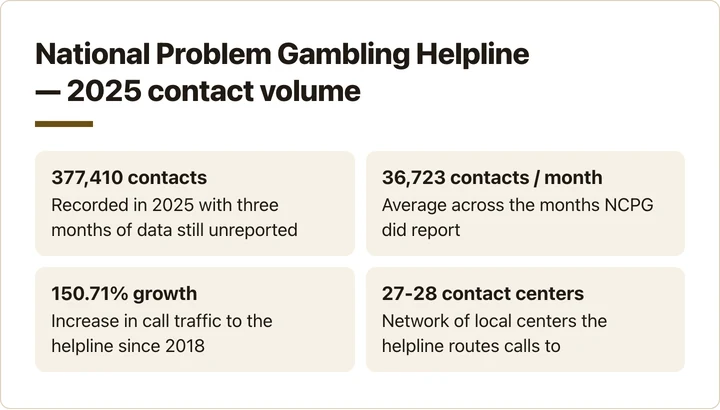
More than a third of a million contacts reached the helpline in a single year, and that is with three months uncounted. The volume suggests problem gambling is a mainstream public health concern touching hundreds of thousands of Americans annually.
Call traffic to the helpline has grown 150.71% since 2018. That growth likely reflects multiple factors. Increased awareness of the helpline itself plays a role, as does the expansion of legalized gambling across more states and a gradual destigmatization of seeking help. It may also reflect a funnel effect. As more people gamble, more people encounter problems, and more people find their way to support services.
If you are wondering whether your gambling is a problem, you are not alone, and you are not an outlier. The helpline handles tens of thousands of contacts every month. Reaching out puts you in well-trodden territory.
What Happens After the Call
For most callers, the helpline contact starts a longer process. The specialist’s referral is a handoff to a system of care that may include:
- Local treatment providers: counselors and clinics specializing in gambling disorder
- Support groups: peer-led meetings such as Gamblers Anonymous
- Self-exclusion programs: state-run systems that allow individuals to voluntarily ban themselves from casinos and online gambling sites
- Financial counseling: services for those dealing with gambling-related debt
The specialist will typically discuss these options during the call and may offer to help the caller make an initial connection, whether that means a warm handoff to a counselor’s intake line, a link to a state’s self-exclusion registration process, or simply a name and number to call back once the caller has decided on a next step. Some callers need only information. Others need ongoing support.
The helpline accommodates both.
A System Designed for a Difficult Moment
The National Problem Gambling Helpline is, at its core, a piece of public health infrastructure. It is a network of trained specialists, a set of routing protocols, and a referral system, all designed to catch people at a difficult moment and point them toward help. The autumn number change was a disruption. The system itself held. The specialists are still answering, the referrals are still flowing, and the contact volume from that year suggests the demand for that service is not going anywhere.
For anyone considering a call, the mechanics are simple. Dial the helpline number, or text, or open the chat. A trained person will answer. They will ask what prompted the call. They will listen. And they will help figure out what comes next. That is the entire job. It reaches hundreds of thousands of callers each year.
Frequently Asked Questions
Is the helpline really free and confidential? Yes. The National Problem Gambling Helpline is free to use and confidential. Callers are not required to provide identifying information, and conversations are not shared with third parties without consent.
What if I’m calling for someone else? Family members and friends are welcome to call. Specialists can provide guidance on how to approach a loved one about their gambling, what resources are available, and how to support someone through the change process.
Does the helpline help with online gambling too? Yes. The helpline serves all forms of gambling, including online casinos, sports betting, and lottery. Specialists are trained to address the full spectrum of gambling activity.
What if I’m not sure I have a problem? That is exactly the right reason to call. There is no threshold for “serious enough” before reaching out. Specialists can help you assess your situation and decide whether any changes are warranted.
What happens if I need more than one conversation? The helpline is available around the clock, so you can call, text, or chat as often as you need. Specialists can also connect you with ongoing local resources if you want longer-term support.
See also Top Tools and Features Supporting Responsible Gambling and Comparing Responsible Gaming Regulations Across Different Countries.
If you or someone you know is struggling with gambling, help is available 24/7. Call the helpline above, text it, or use the chat link. For crisis situations involving immediate danger, call 911 or the Suicide & Crisis Lifeline at 988.