
Online Casino Deposit Methods Compared: Fees, Limits, and Processing Time
- Mason Phillips
- 12 min read

When a player compares online casino deposit methods, the useful comparison focuses on three key dimensions. First is the cost of the deposit. Second is the transaction size limit. Third is the speed at which funds become playable. Cards and e-wallets clear fastest. Bank transfers clear slowest. Prepaid vouchers and crypto sit in between, each with a cost structure that hides in a different place. That table is the practical answer, and it is worth reading closely, because the rail a player chooses also determines how visible the deposit is to the systems that track it.
The comparison table, method by method
The numbers below represent typical ranges; actual terms vary by provider. Banks, wallet providers, and individual platforms set their own terms, and verification tier changes the ceiling on almost every method.
| Method | Typical deposit fee | Common per-transaction range | Time to playable funds |
| Debit or credit card | Usually none | $10 to $10,000 | Instant |
| E-wallet (PayPal, Skrill) | 0% from wallet balance; ~1% if card-funded | $10 to $5,000 | Instant |
| Bank transfer | Usually none | Varies by bank | 1 to 3 business days |
| Prepaid voucher | Fee paid at purchase ($1.49 to $3.49) | ~$40 unregistered, toward $1,000 registered | Minutes |
| Crypto | Network fee only, typically under $1 | ~$10 minimum | 10 to 30 minutes |
Two patterns stand out. First, the fastest-crediting methods carry hidden costs that add up beyond their upfront simplicity. Second, the slowest method is often the one with the fewest line-item fees; the primary cost appears as a time delay spent waiting.
Card deposits: instant, cheap, and capped by the bank
A card deposit is the default for most players because it requires nothing new. The card is already in the wallet. The transaction runs through the same authorization network as any retail purchase, and the platform receives a confirmation within seconds.
Fees are typically zero on the player side. The platform absorbs the merchant processing cost, which is part of why card limits vary so widely: a bank may allow a $10,000 transaction from a well-verified account and decline a $500 one from a newer customer on the same platform. Per-transaction limits commonly run from $10 at the floor to ten thousand dollars at the ceiling, and the ceiling depends on both the issuing bank and the player’s verification tier.
Withdrawals are a separate mechanism, and they behave differently. A card withdrawal can take one to five business days, because the money is moving back through an authorization and settlement process built primarily around purchases. A player who deposits instantly and withdraws to the same card should expect the outbound leg to be slower than the inbound one.
The card’s biggest constraint stems from regulation. In some jurisdictions, certain card types are blocked from gambling transactions outright, which is where the UK example later in this article becomes relevant.
E-wallets: fast, flexible, and fee-layered
An e-wallet sits between the bank and the platform. The player funds the wallet once, then deposits from the wallet balance. That extra step is what produces the speed and the fee structure.
PayPal is the simplest case. Typical minimums run $10 up to around thirty dollars, deposits are usually free, and crediting is instant. Withdrawals land same-day to 24 hours, which is faster than a card withdrawal by a wide margin.
Skrill shows how fees stack. A deposit funded from an existing wallet balance carries a 0% fee and credits instantly. Funding the deposit from a card instead adds roughly a 1% card-load fee. If the wallet balance and the deposit are in different currencies, conversion adds about 4%. Withdrawals cost about 1.5% to a bank transfer, or a flat few dollars via ACH. Account maximums often reach $5,000 depending on verification tier.
The pattern is consistent across wallet providers. The deposit itself is free from wallet balance. Loading the wallet, converting currency, and cashing out each carry their own fees. A player who keeps one currency and funds from a bank account pays almost nothing. A player who moves between currencies pays for the convenience.
Bank transfer: the slowest rail with the fewest line items
A bank transfer moves money directly between financial institutions, bypassing the card networks and wallet intermediaries. It is the slowest common method, typically one to three business days to clear, sometimes longer depending on the issuing bank and the jurisdiction.
There is usually no deposit fee. The tradeoff is that the funds are not available to play with until the transfer settles. A deposit initiated on a Friday afternoon may not be playable until the middle of the following week, depending on how the two banks batch their processing.
Bank transfers suit players moving larger amounts who are not in a hurry, and they suit players who want the transaction to appear as a direct bank-to-bank transfer on a bank statement. They are a poor fit for anyone who wants to deposit and play in the same session.
Prepaid vouchers: the fee is paid before the deposit
A prepaid voucher works like a gift card with a PIN. The player buys the voucher with cash or a card at a retail location, then enters the PIN on the platform. The deposit credits within minutes.
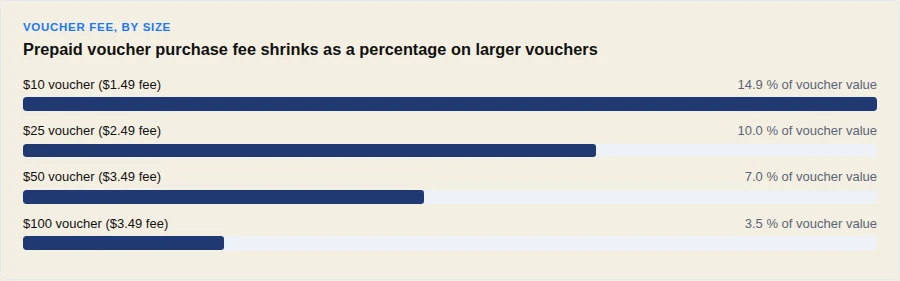
The deposit itself carries no fee. The cost is paid at purchase, and it is regressive. Typical fees run roughly $1.49 on a ten-dollar voucher, $2.49 on a twenty-five-dollar voucher, and $3.49 on fifty or hundred-dollar vouchers. As a percentage, the smallest ten-dollar voucher incurs about 15% fee, while the largest hundred-dollar voucher costs roughly 3.5%. Buying larger vouchers lowers the effective rate.
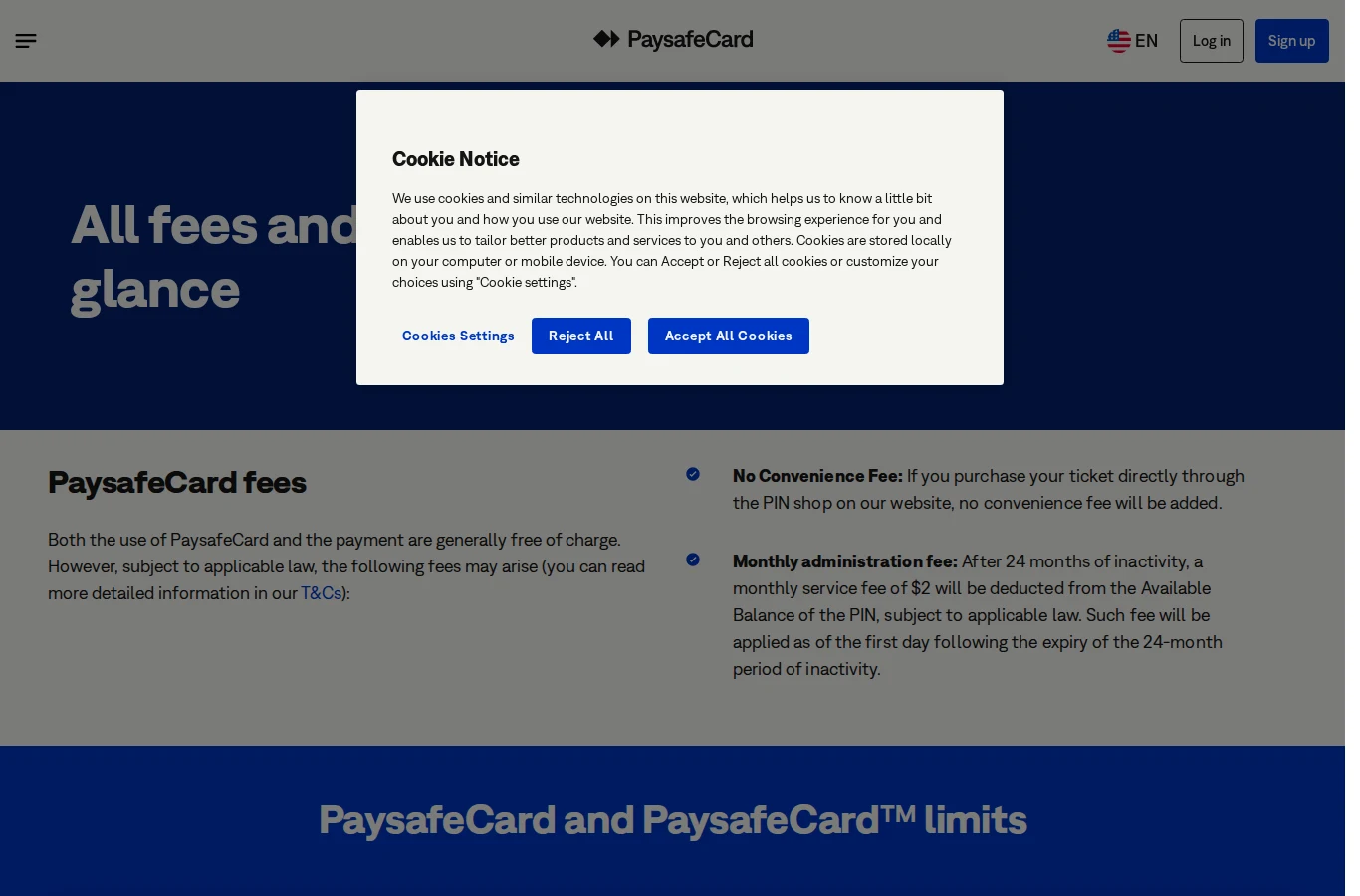
Two limits matter. An unregistered PIN transaction caps around $40, while registering the voucher with the provider raises the usable limit toward $1,000. Separately, 24 months of inactivity can trigger a small monthly service fee on any remaining balance, which quietly erodes money that was never deposited.
Vouchers appeal to players who want to deposit without linking a bank account or card, and the tradeoff is the upfront fee plus the registration step required to move meaningful amounts.
Crypto: fast settlement, network-dependent timing
A crypto deposit settles over blockchain networks using decentralized ledger confirmation. The platform generates a deposit address, the player sends coins, and the balance credits once the network confirms the transaction.
Confirmation usually takes ten to thirty minutes. Major chains produce a block roughly every ten-minute interval, and many platforms wait for one to three confirmations before crediting. When the network is busy, that window stretches.
Fees are limited to the network or miner fee, which on major chains typically runs well under $1 in normal conditions. Minimums commonly sit around ten dollars in value. Some major coins carry no stated maximum, while smaller coins on the same platform may cap lower based on the platform’s liquidity constraints.
The practical risk with crypto is timing variance. A deposit that takes ten minutes on a quiet network can take considerably longer during congestion, and the player has no way to speed it up once the transaction is broadcast.
Why the method matters less than the limit attached to the account
Here is the part that the fee table does not show. Deposit limits and affordability checks are attached at the account level, spanning all payment methods used by that player. A player who hits a limit on a card cannot reset it by switching to an e-wallet, because the limit is tracked against the account across every method used.

The United Kingdom’s incoming rule makes this explicit. Starting September 30th, 2026, pushed back from an original mid-June 2026 date, UK-licensed operators must offer deposit limits as a gross figure over a fixed time window. Gross means the raw total deposited; withdrawals already taken back out are not subtracted from that total. A player who deposits $500, withdraws $300, and deposits $200 more has deposited $700 against the limit in total.
The same rule requires operators to prompt every new customer to set a deposit limit at registration. From 31 October, operators must prompt a limit choice before a customer’s first deposit if one has not been set. The limit is tracked at the account level across however many payment methods the player uses. The same account-level limit remains in effect whether the player switches from card to e-wallet to add money faster or stays with one method.
This is the mechanism that makes method-shopping ineffective as a workaround. Speed of money arrival depends on the payment rail chosen. The account-level cap constrains total money arriving regardless of method.
The UK credit-card ban as a comparative example
The United Kingdom also illustrates how a regulator can build a safeguard directly into the payment layer. Since 14 April 2020, UK-licensed operators have been required under Licence Condition 6.1.2 to decline credit-card gambling deposits entirely, routing funding through debit card, e-wallet, or bank transfer instead.
The regulator’s stated reason was that credit cards appeared disproportionately in problem-gambling cases, cited as used by up to 22% of identified problem gamblers in its consultation evidence. The rule treats the payment method itself as a risk factor, separate from the size or frequency of any individual deposit.
This is a foreign rule, not US law. US players are not subject to Licence Condition 6.1.2, and no equivalent federal credit-card ban applies to them. The UK example is useful because it shows what a payment-layer safeguard looks like when a regulator decides the rail itself is part of the problem. It also illustrates a key limitation: banning one method alone cannot control total deposits, which is why the gross deposit limit rule was added to work alongside the credit-card restrictions.
Affordability checks run regardless of the rail
The UK’s automated affordability checks follow the same logic. Financial risk assessments based on credit-reference data trigger once a player’s net deposits cross roughly £150 within a rolling thirty-day window. When the first assessment flags a concern, a more detailed second-stage check proceeds to further evaluation.
The key detail is that these checks run regardless of which deposit method funded the money. A player who deposits £150 by card, by e-wallet, or by bank transfer crosses the same threshold and triggers the same assessment. The method changes the mechanics of the transfer, but the account-level assessment framework remains constant.
For players in any jurisdiction, the practical implication holds regardless of where they play. The tools that constrain deposits are designed to be method-agnostic. They count the total, not the route.
What each method actually protects, and what it does not
No deposit method is inherently safer to gamble with. Each one changes the mechanics of a transfer, and each one carries a different set of tradeoffs, but none of them changes the underlying math of how much money is going out.
A card is fast and cheap, and it leaves a clear transaction record. An e-wallet adds a layer of separation from the bank account, which some players prefer and which also makes the spending slightly less visible on a bank statement. A bank transfer is slow; the processing delay creates a natural cooling-off period through how settlement systems work by default. A prepaid voucher caps the amount that can be deposited without registration, which limits exposure but charges a high percentage fee for the privilege. Crypto settles quickly and carries low fees, and its timing variance makes it a poor fit for anyone who needs funds playable at a specific moment.
The safeguards that matter most, deposit limits and affordability checks, sit above all of these. Deposit limits sit alongside self-exclusion and reality checks as one of the standard player-protection tools, and they operate at the account level precisely because method-level limits are easy to route around.
It is also worth noting that these rules are not universal — different regulators take different approaches. The UK’s gross deposit limit and credit-card ban are one model. Other jurisdictions rely on different combinations of operator-level requirements, self-exclusion registries, and mandatory spending prompts. A player who moves between jurisdictions, or who plays on platforms licensed in more than one, should expect the rules attached to the account to shift with the licence, independent of the payment method used.
The practical takeaway is that the fee table answers the question the keyword asks, and the account-level rules answer the question that matters more. Choosing a deposit method focuses on speed and cost optimization, while selecting the payment rail does not affect how much money can be deposited in total, since account-level limits constrain the total across all methods.
FAQ
Which deposit method is fastest? Cards and e-wallets credit instantly or near-instantly. Prepaid vouchers credit within minutes once the PIN is entered. Crypto takes roughly ten to thirty minutes depending on network confirmations. Bank transfers are the slowest at one to three business days.
Which deposit method has the lowest fees? Bank transfers and card deposits usually carry no player-side fee. Crypto carries only the network fee, typically under $1 on major chains. E-wallets are free when funded from a wallet balance but add roughly 1% for card funding and about 4% for currency conversion. Prepaid vouchers charge $1.49 to $3.49 at purchase, which is a higher percentage on smaller vouchers.
Can a player avoid a deposit limit by switching methods? No. Deposit limits are tracked at the account level across every payment method used. Switching from card to e-wallet does not create a second allowance under the limit.
Do affordability checks depend on the deposit method? No. The UK’s automated financial risk assessments trigger based on net deposits crossing roughly £150 in a rolling 30-day window, regardless of which method funded the money.
Are credit-card gambling deposits banned in the US? No. The UK’s credit-card ban applies to UK-licensed operators only under its gambling licensing framework. US players are not subject to that rule, and no equivalent federal ban applies to them.
See also Top Tools and Features Supporting Responsible Gambling and Comparing Responsible Gaming Regulations Across Different Countries.
Gambling is for adults only (18+). If you or someone you know is struggling with gambling, help is available 24/7 through the National Problem Gambling Helpline (1-800-522-4700) or GAMSTOP-style self-exclusion tools. For crisis situations involving immediate danger, call 911 or the Suicide & Crisis Lifeline at 988.